Site founded September 1, 2000, passing 300,000 page views in January 2005
These home pages remain free of any charge. We need donations or subscriptions/gifts for students, military and family. Please pass on this website link to your family, relatives, friends and clients.

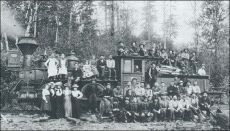
(Seattle & Northern 1890)

Skagit River Journal

of History & Folklore
Subscribers Edition Stories & Photos
The most in-depth, comprehensive site about the Skagit.

Covers from British Columbia to Puget sound. Counties covered: Skagit, Whatcom, Island, San Juan. An evolving history dedicated to the principle of committing random acts of historical kindness
Noel V. Bourasaw, editor (bullet) 810 Central Ave., Sedro-Woolley, Washington, 98284
Home of the Tarheel Stomp (bullet) Mortimer Cook slept here & named the town Bug

(Click to send email)

Skagit County Times

      Woolley and Sedro. Owned, issued and operated by Ketchum Printing Co., Seneca G. Ketchum, manager. Subscriptions $1/year. Ads: $1/inch/month, reductions for time and space. Published Thursdays. [You can read about the colorful career of Seneca Garrett Ketchum, as lawman and editor from British Columbia to Fairhaven to Spokane to Woolley, in Issue 25 of the separate Subscribers Edition.
Jan. 26, 1899, Volume 9, Number 1
National and World news:

News of the United City: now chimes the cheerful
local bell and newsy echoes rise and swell:

Electric Light Co.
      Attorney Schrauger came up from Mount Vernon some days ago and made a proposition on behalf of the Mount Vernon Electric Light Co. to move the electric plant and business to this town. The only things the company ask are a site and the individual support of our citizens. A meeting was called to hear Mr. Schrauger's remarks on behalf of the company and the proposition was received with much favor.
      A committee was appointed to look after a site and are now about ready to report that they have been successful in their negotiations. It is said on good authority that the Mount Vernon Electric Co. has never been able to put the business on a paying basis at the county seat and has contemplated this move to Sedro-Woolley for some time. The city council took action in the matter last Saturday, as well be seen in another column.
      [Ed. note: Thanks to Dick Fallis's 1986 Walking Tour of Mount Vernon, we know that, in the summer of 1891, W.H. Franklin bought a small set of generators at a receiver's sale and set up the Mount Vernon Electric Co. It was located at what is now the northwest corner of Kincaid and First streets where Vaux Pharmacy was located for years until 2003. From other old records we know that the company never did succeed financially and the move to Sedro-Woolley never was successful. In 1912, Franklin sold out to Puget Power and the electric Interurban Railroad depot was located there from then to 1926.]

Prairie:

Deaths:

Marriages:

Senator Hammer and the barbers union
      The unfortunate gentleman with a thin cuticle and a strong beard will thank Senator Hammer if his bill relating to barbers becomes a law. It is being pushed by the barbers' unions. It requires a board of three examiners, who have authority to issue certificates to barbers and compels all barbers to be registered. Senator Hammer should still further improve the bill so that our long-whiskered friends of the Pop persuasion would be required to remove the alfafa from their physiogs. This would keep barbers busy underbrushing, and also curtail the powers of calamity bowlers, whose chief occupation and delight is to talk at random through their whiskers. [Ed. note: Senator Emerson G. Hammer was the center of a large extended family that included his father-in-law George Green, who was the founder of Lincoln, Kansas, before they all moved out here. Emerson came with his bride, Isabel, in 1889. Read about all the families at this Journal website.

Loggers' Right of Way
      Loggers will be interested in the bill introduced by representative [Joseph H.] Parker of this county, giving to logging companies a right of way over public lands for the transportation of logs. The bill is designed as an amendment to the law providing for the survey, selection and approval of public lands of the state. It is provided that the logger desiring a right of way shall apply to the board of state land commissioners, who shall investigate the matter and allow the application if it does not conflict with other rights or with the rules of the commission.
      If the bill is passed it will be of value to the loggers of the state, and there seems at this time to be little doubt that Representative Parker will succeed in carrying the message through. The special correspondent of the Post-Intelligencer at Olympia says that Mr. Parker is one of the careful and hard-working members of the house, who makes many friends, and his course always leads to a successful record.


The colorful Hoo-Hoos
      The state concatenation of the Concatenated Order of Hoo-Hoo was held at Seattle Saturday, January 14th. Skagit county yielded three members for the initiation ordeal at this concatenation and all came through alive. They were Maynard P. Hurd, the new prosecuting attorney of the county, and Alexander B. Melville and Albert Baldwin, prominent millmen of Clearlake.
      Quite a delegation went down from this part of the country to assist at the interesting ceremonies and also at the banquet. From Sedro-Woolley there went D.J. Cain, C.E. Bingham, H.H. Shrewsbury, J.C. LaPlant and A.E. Holland; from Lyman, B.D. Minkler; from Clearlake, J. McMaster, and the three candidates mentioned above; from Biglake, Walter A. Parker. Hon. Joseph H. Parker ran over from Olympia to take a hand in the fun.
      [Ed. note: The Hoo-Hoo is a fraternal group that even iconoclasts can embrace. Unlike almost all of the fraternal and secret societies that popped up like mushrooms in frontier towns, the Hoo-Hoo lodges are still very much alive and well, still dedicated to promoting the forest products industry and the welfare and long life of their fellows. There are some parallels between this group and the Eagles, which grew a few years later in Seattle. It was dreamed up almost on a whim by five lumbermen on Jan. 21, 1892, in Gurdon, Arkansas. They were on their way to a convention and their train was delayed. They rejected the idea of parades or funny fezes, but they did devise a secret way for club members to communicate. Thus the black cat and the variations of the number nine play a strong role in the mythology of the club. One of the organziers had just finished reading Lewis Carroll's Hunting of the Snark, so the Grand Snark was the supreme officer, assisted by the Holy Bojum, the Scrivenoter, the Arcanoper and many others.] At first, there were no individual lodges; members were part of the grand lodge. Now, there are regional groupings, including several lodges that are very active in Washington state. The next time you paw your way through a used book store, look for the book published for the lodge's centennial, Log & Tally. You can also look at this official website to find the full history of the lodge, or this great article if that does not open. As the members say: "Once a Hoo-Hoo, always a Hoo-Hoo."

Government:
Would make a dicker. Receivers anxious to sell old Joint Town Hall
Councilman Hosch says it is no good

      The matter of the purchase of the town hall was again brought up [at the city council meeting of Jan. 21, 1899]. Councilman [Dr. M.B.] Mattice referred to it, saying that the peculiar state of affairs made it appear that the city would in this transaction be required to pay [illegible] for the property. Councilman Hosch expressed similar objections and asked what had become of the money collected by individual citizens. Treasurer [William] Doherty explained that this had been credited to the current expense fund of Woolley and the building paid for out of such fund.
      Councilman Mattice suggested that the receivers advertise for bids for the building. Receiver [W.T.] Odlin said that no private individual would bid anything like the actual value of the property; the town was compelled to have a building, this is adapted to the purpose; as far as concerns paying twice for the property the idea was fallacious, as the transaction simply releases property held for that much.
      Councilman Hosch said the jail was no good; the council room was all right but the jail was unventilated and anyone could get out of it; he thought a suitable building could be secured for less money. Councilman [F.A.] Douglass, having arrived, said that in his opinion the cost price of the building was more than could be realized from its sale and thought it the best plan to advertise for bids as suggested by Councilman Mattice. Receiver Odlin remarked that it was just a case of incurring a new debt to pay an old one and thought that the sooner the old debts were settled, the sooner that source of expense would cease to exist; he thought a fair offer had been made in the proposition to turn the building over to the new municipal corporation at its net cash cost. The matter was laid over for future consideration.
      [Ed. note: After all that, we winced when we realized that the writer never mentioned the location of the old hall. We know that meetings of the council of P.A. Woolley's company town, before the merger, were conducted in a store someplace on Metcalfe street. But the only city hall we know of is the one for Sedro, the location for which the late Howard Miller pointed out for us at the corner of Jameson and Seventh streets. He recalled that when he was a boy, the old former town marshal, Chan Ingham, told him that there was a bell tower on that building that alerted people to fire and flood emergencies.]


Liquor License ordinance:
      Ordinance No. 7 was then brought up for discussion. This ordinance deals with the matter of liquor licenses and provides that applications for license shall be made in writing, signed by the applicant and accompanied by a bond in the penal sum of $1,000, conditioned that the applicant shall keep an orderly house, shall not sell liquors to minors, will comply with all the requirements of the law and will pay all judgments that may be recovered against him for violation of the same. It is provided that licenses shall be issued for the period of one year only, and that the fee charged therefor shall be $500.
      Councilman Mattice stated that the object in raising the license fee was to discourage the establishment of the less desirable class of saloons which a lower tax might permit or induce; better have fewer saloons and have them of a better class. James Gray addressed the council, objecting to the increased tax and adding that he thought it only fair that other lines of business should be called upon to contribute their share toward the payment of the expenses of the corporation. The ordinance was passed by the following vote: For — Villeneuve, Douglass, Mattice; Against — Hosch.
      [Ed. note: Hosch's no vote should not be a surprise. Hosch owned one saloon or another in Woolley since 1890, most of the time at the Gem Saloon, next door to the Keystone Hotel. He was also a member of the Woolley City Council for most of the 1890s before being elected in 1899 to the council of the merged towns. For more stories about the early saloons of Skagit county, see these Journal websites: http://www.geocities.com/skagitriverjournal/SaloonsUpriver1.html and http://www.geocities.com/skagitriverjournal/LiquorLicenses.html ]


Two of the sections of Ordinance 7 follow:
      Section 11. No lewd men or women, minors or Indians shall be permitted to loiter or remain about places where intoxicating liquors are sold, and no license under this ordinance shall sell, give or dispose of any intoxicated liquor or to any minor, Indian, intoxicated person or habitual drunkard, and for the violation of any of the provisions of this ordinance the said licensee, or any one acting for him or in his employ, shall be subject to the same penalties as provided in Section Ten of this ordinance, and shall, in addition thereto, be liable to pay to the town of Sedro-Woolley the sum of one hundred dollars, to be recovered by a civil action therefor, and the sureties on his bond shall be liable on his bond for the payment of said amount.
      Section 12. For the violation of any of the provisions of this ordinance the Council may, in addition to the penalties above provided, revoke any license granted thereunder; but before revoking any such license the holder thereof must be notified in writing at least five days prior thereto that the said Council have under consideration the revocation of his said license and the cause therefor, and that if he desires he can be heard in opposition to such revocation at a meeting of the Council to be therein stated before the same is revoked. Upon the revocation of any such license the Clerk must notify, in writing, the person building the same that his said license has been revoked, and from and after such notification said license and all rights and privileges thereunder shall cease and be at an end. Passed Jan. 21, 1899.


Ordinance No. 9 — revenue for the new city
      [Ed. note: Back in the days before sales taxes and property taxes — as we now know them, the newly merged city of Sedro-Woolley mainly derived its revenues from "sin taxes," or bonds, fees and fines associated with entertainment and naughtiness.]
      Ordinance No. 9: an ordinance in relation to the collection of fines and costs of suit in cases of misdemeanor.
      Section 1. Whenever any person shall be convicted of a misdemeanor under any of the ordinances of the town of Sedro-Woolley and sentenced to pay a fine and costs of suit, and shall fail, neglect or refuse to forthwith pay said fine and costs, it shall be the duty of the Marshal of said town to immediately take such person so convicted into custody and imprison him in the town jail for a period of time that will be equal to the full amount of such fine and costs by allowing him a credit of three dollars per day for each day so imprisoned; Provided, That it shall be the duty of the Marshal of said town to provide suitable employment for all such persons so convicted (except women) upon the streets or other public improvements of said town, and he shall cause all such persons to work and labor for a period of at least eight hours each day upon the streets or other public improvements of said town.
      Section 2. In all cases of conviction of a misdemeanor under any of the ordinances of the town of Sedro-Woolley, it shall be the duty of the police justice or other magistrate before whom said conviction is had to adjudge and tax against the party so convicted all costs of prosecution, which shall include all fees of the police justice or other magistrate, which shall be taxed in such sums and amounts as are by law allowed to justices of the peace for similar services, and also the marshal's or constable's fees, equal in amount to those allowed by law to constables for similar services, and shall also include an attorney's fee of two dollars and fifty cents in all cases in which the town attorney shall appear on beahlf of the prosecution.
      Section 3. This ordinance shall take effect and be in force from and after its publication in the Skagit County Times.
      — Norris Ormsby, mayor. Attest: F.F. Willard, clerk. Passed Jan. 21, 1899.


New county officials:

Bonds were approved:

Jan. 3, 1899 Board of Commissioners,
some of the authorized payments:

Advertisements and business news:


Feb. 2, 1899 issue
Local and state news:

April 6, 1899 issue
Ads

June 8, 1899 Supplement No. 2 to regular edition
Mill Man's Burden
by Thomas W. Tressider
Take up the Mill Man's burden —
      Put forth the best ye know.
And try with toil and anguish
      To get the thing to go.

Wrestle with chain and engine —
      Your half-taught weavers wild —
Your pestilent knot-sawyer,
      Half devil and half child.

Take up the Mill Man's burden —
      And dwell to fortune's frown;
With timber scare and rising,
      With shingle prices down.

Then, when your path seems smoother,
      And there is time to joke,
A spark strikes on your dry house —
      Sit down and watch your smoke.

Take up the Mill Man's burden —
      No joyous snap is this;
A grind on mind and muscle,
      Empty of ease or bliss.

The notes ye may not cancel,
      The bills ye can but owe,
Go, stay them to your worry,
      And pay them to your woe.

Take up the Mill Man's burden —
      And reap his old reward —
Bad faith and broken promise,
      Deals that are harsh and hard;

The sneers of those ye favor,
      The jeers of those ye aid,
Their fawning it ye flourish,
      Their flouting if ye fade.

Take up the Mill Man's burden —
      And lay it down again!
Then jump with joy exulting
      At being free from pain.

Better the farm or foundry,
      Better the spade or shears,
Than cutting the cedar shingle —
      Is the judgement of your peers.


July 13, 1899

Local news:

Advertisements:

Mortimer Cook Goes Hence
To the Philippines He will Hie, to Return with Boodle Bye and Bye

      Mortimer Cook, shrewd, kind-hearted, brusque and much-revered Mortimer Cook, is going to the Philippine Islands. He leaves from Vancouver, B.C. about 31st inst., on the Empress of India. This boat has carried other distinguished people across the Pacific, but none ever trod her decks that had with them the same measure of love and confidence of friends as Mortimer Cook.
      Mr. Cook came to this place when it was yet unborn and set up a sawmill on the banks of the majestic Skagit. The business prospered, the population about the mill-site grew, and it became necessary to have a post office. Mr. Cook was asked to establish such an office and select a name. He called the place Bug. After awhile this name became distasteful to the people, because outsiders would refer to them as being buggy, and a man wanted to start a hotel and call it the Bughouse. The inhabitants kicked and the name was changed to Sedro, which is a corruption of the Spanish word cedra, meaning cedar
      Since then Mr. Cook has been a rancher, a politician, a banker and a merchant, and has achieved two or three fortunes of comfortable dimensions. Each of these he lost by speculation and philanthropic donations. Now he is going over to Uncle Sam's new possessions to secure another pile, for although Mr. Cook might be considered an old man in a physical sense, mentally he is as strong and vigorous as a man in his prime of life.
      His present idea is to go over there and establish a sawmill, and soon we may expect to hear of him cutting up the sugar cane into sugar and the mahogany into logs. There among the Taglos, the yam yams, the Manila cigars, the gorilla and the relics of the late war, Mr. Cook will surely flourish. Where the perverse and wayward Aguinaldo once shot cold, indigestible lead into the diaphragms of the old American volunteer, Mr. Cook will plant his patriotic flagstaff and defy competition in cutting up lumber and using expressive and vigorous language. Mr. Cook will teach his Taglos workmen how to talk in the Woolley and picturesque language of Western Washington, where the American Eagle some times gets up in the night and screeches like hell for more pie. In his particular case the damn will always be there by the millsite.
      As Mr. Cook has demonstrated that he is something of a poet himself, not be entirely outdone, The Times will drop into beautiful verse to wish him bon voyage.


Farewell, Mr. Cook, you have taken a notion
To hie to new colonies over the ocean;
May you come back again to the friends you have shook
With a hatful of money, dear Mortimer Cook.

In fancy we see you conducting a mill,
And driving your Taglos with restless good will;
May the stars and stripes be as proud as they look
As they wave O'er your efforts, dear Mortimer Cook.


Undated advertisement at the same time period:
Off, off, off to see —
Grandpap Gorilla,
Down near Manila,

Examine his teeth, his muscle and eyes,
And try to decipher who is most wise,
Carnegie, Rockefeller, old Russell Sage,
And other "swell heads" of this rotten age

Or our old grandpap
Who could with a snap

Rip the stuffin' out of several dozens
Of these rotten, degenerate cousins.
Oh! tell me, tell me, forsooth,
Which of them is nearest the eternal truth?


Advertisement by Mortimer Cook
      And now I jump the country.
      My shop will be open during June from 7 a.m. til 8 p.m. for blood, unless sooner sold in a lump, There are very many useful things here; tinware, kitchen furniture, crockery, cooking utensils, glassware, notions of all sorts, trunks, valises, traveling bags, shoes, hats, undershirts and drawers, pants, coats, sox, baskets, lap-robes, some dry-goods and a thousand thousand other things, all useful and of everyday use. they will not be given away at any price, but all will be sold cheap — much cheaper than usual, and below prices anywhere; they were all bought cheap for cash in advance.
— Mortimer Cook, Sedro-Woolley


Letter written Nov. 22, 1899,
received by Mortimer's daughter, Jan. 2, 1900
From Brigade Hospital, Iloilo, Philippine Island
To: Mrs. Fairie Cook Litchfield, Plaza Hotel, Chicago, Illinois

Dear Madam:
      I write you this letter in relation to your father, Mr. Mortimer Cook, who died in this hospital on Nov. 22, 1899. My first introduction to him was on Nov. 1st when a message came from the hotel requesting a physician to come and see him.
      It was found that he was suffering from acute Dysentery and as proper care could not be given him there, it was thought advisable to bring him to the Hospital, where he has been under constant attention since that date.
      Every possible effort was made to check the disease but without success. His age [75] was a serious obstacle, and his recuperative power was lacking. His courage was not lacking and he was hopeful almost to the end.
      The case was practically hopeless from the beginning, but I was encouraged to hope from the fact that his strength held out for so many days, that he might recover.
      A special [illegible] was detailed and he was given every possible care and attention. The day previous to his death he called me to his bedside and informed me that he was satisfied the end was near at hand, and that he wished to speak to me privately.
      He spoke of the family in general and said he wished to again attended to by Captain Butler, U.S. Vols., with whom he had had business relations, and that his effects and money were to go to you, and this will be attended to.
      The end came peaceful and he was conscious to the last. He was buried today in the cemetery at this place and proper records of the interment made.
      Very respectfully, G.H. Calkins, Acting assistant surgeon, U.S. Army P.S. Burial certificate enclosed. Buried in a grave adjoining grave No. 15 as shown on official plat of cemeteries


      [Ed. note: The upcoming Issue 26 of the Subscribers-Paid Journal magazine online will be focused on Mortimer Cook and his amazing family, from his birth in Ohio, to his service in the Mexican-American war and his trading post in Texas afterwards, to his time as a storekeeper in '49er gold country, to his pack trains from Whatcom during the 1858 Fraser river gold rush, to his trading post at Cook's Ferry on the Thompson river in British Columbia, to his marriage back in Ohio, to his business in Topeka, Kansas, to his bank in Santa Barbara, California, and his time as mayor there, to his move to the Skagit river in June 1884. For now, you can read more about him at this Journal website about Cook and you will find links there to other Cook features. (Link repaired]

Story posted on April 18, 2004
Did you enjoy this story? Please consider subscribing to the optional Subscribers Edition. That is how we fund this grand project.
Please report any broken links or files that do not open and we will send you the correct link. Thank you.


You can read about our prime sponsors:
Read the history websites of our sponsors and supporters, who help fund research of local history:
Heirloom Gardens Natural Foods at 805B Metcalf street, the original home of Oliver Hammer.
Oliver Hammer Clothes Shop at 817 Metcalf street in downtown Sedro-Woolley, 82 years.
Bus Jungquist Furniture at 829 Metcalf street in downtown Sedro-Woolley, 36 years.
Schooner Tavern/Cocktails at 621 Metcalf street in downtown Sedro-Woolley, across from Hammer Square.


Peace and quiet at the Alpine RV Park, just north of Marblemount on Hwy 20
Park your RV or pitch a tent by the Skagit river, just a short driver from Winthrop or Sedro-Woolley.


Would you like to buy a country church, pews, belfry, bell, pastor's quarters and all? Email us for details.
Looking for something special on our site? Enter name, town or subject, then press "Find"
Search this site powered by FreeFind
Did you find what you were looking for? If not, please email us and tell us what you seek and we will put it on our list to research. The more details, the better.
Please sign our guestbook so our readers will know where you found out about us, or share something you know about the Skagit River or your memories or those of your family. Share your reactions or suggestions or comment on our Journal. Thank you for taking time out of your busy day to visit our site.
Sign Our Guestbook Get your own FREE Guestbook from htmlGEAR
View Our Guestbook
Remember, we welcome correction and criticism. Please click on the email slot at the right to report any problems with these pages or to suggest ideas for future stories. This is a completely free site. We fund it by providing an online magazine for paid subscribers. If you are not already a subscriber and you would like to help support our considerable research costs, you can subscribe for just $20.00 per year. As a paid subscriber, you will receive eight yearly issues plus many rare treats between times, including scans of photos and documents that illustrate local history, before they are shared with anyone else. You can go here for Subscription details and you can read the preview edition to see examples of our in-depth research. You may also order gift subscriptions for friends, family or clients who are interested in local history or students or military people who are away from home. Or you can email us for more details. Do you have scanned photos to share? Or you can mail us copies. See addresses to right.
Email us at: journal@stumpranchonline.com
(Click to send email)
Mail copies/documents to street address: Skagit River Journal, 810 Central Ave., Sedro-Woolley, WA, 98284.